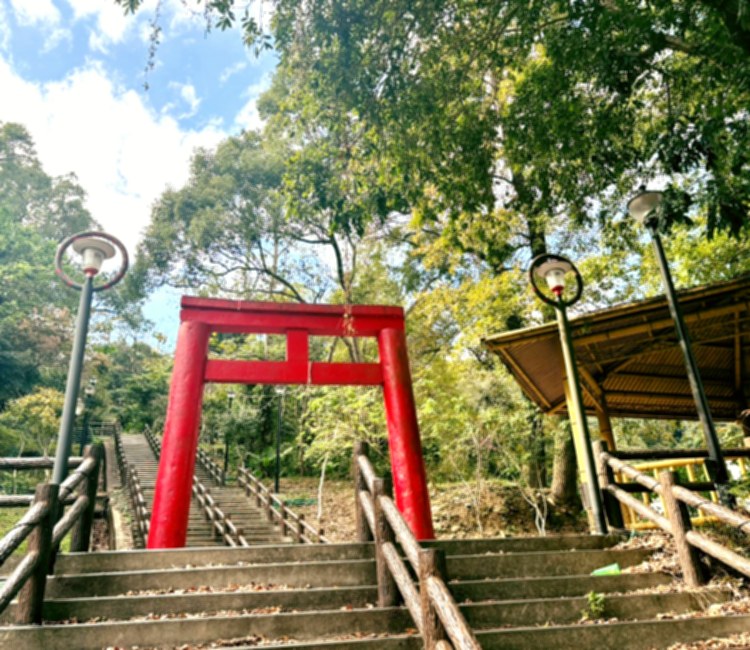
Stepping onto the Wufeng Shiba'er Torii Trail, my first thought wasn't "Time to start climbing," but rather—wow, this place is practically a Japanese drama filter!
An ancient red torii gate immediately grabs your attention. Before you even take out your phone, you're already automatically snapping photos. Walking beneath the torii gate, the light and shadow play across the ground in patches, easily creating the illusion that you're filming a travel show, only lacking the narration: "Now you've arrived at the hidden trail of Wufeng, Hsinchu..."
The beginning was relatively friendly; you could walk, admire the torii gates, and take photos—the atmosphere was very touristy. But as you climbed higher, the steps immediately reminded me—this wasn't just a photo opportunity; it required some legwork. My companions, who were initially chatting, collectively switched to energy-saving mode halfway up, with only the sounds of breathing and footsteps encouraging each other.
The most interesting thing was the change in everyone's expressions: excited faces at the beginning, completely absorbed in taking photos of the torii gates; focused faces towards the end; and then, a complete "Why did I even come here?" look as you climbed higher. I'm the typical hiker who keeps reassuring myself as I go, counting the steps and telling myself, "The scenery will make up for it soon."
Sure enough, once I reached a higher point, the view opened up, the mountain scenery unfolded before me, and the wind blew through the forest, instantly forgiving my earlier panting. Standing there for a few seconds, watching the clouds slowly drift by, I suddenly realized: this is the meaning of climbing all this way.
The most captivating aspect of the Shibashi Torii Trail isn't just the torii gates themselves, but the perfect combination of "taking photos + sweating + relaxing." Some people were busy hydrating, others were stretching, and I was responsible for leaning against the railing, enjoying the breeze, and reflecting on all the moments of the day—cycling, walking through the old streets, eating popsicles, and admiring the scenery.
Looking back at the row of torii gates one last time before leaving, I silently concluded: this trail isn't easy, but it's well worth it. It makes you stop to admire the view, then question your life choices due to the steepness, and finally, the mountain breeze and the panoramic view complete the experience. For me, the Wufeng Shiba'er Torii Trail is the kind of place that my legs will remember, my eyes will be grateful for, and I'll keep thinking about it when I get home.
The Shibaji Shrine, located in Wufeng Township, Hsinchu County, was built in 1927 (Showa 2) and was once the center of local faith. The shrine mainly enshrines Amaterasu Omikami, Emperor Meiji, and Prince Kitashirakawa Yoshihisa. Its name "Shibaji" is a transliteration of the Atayal word Spazy (five peaks).