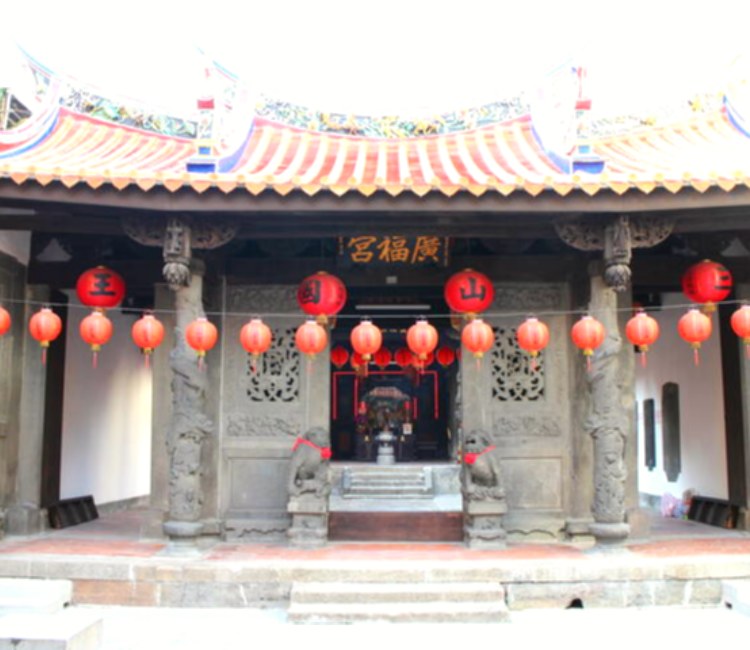
Amongst all the temples alongside the xinzhang old street, I found the real peace in Guang Fu Temple as there are few visitors, no fancy decorations painted in every corners and pillars, no noisy background music played through a broken CD player.
It’s a real monument and as you can see in the photo, even the history steles of this area are also preserved in this temple.
The other temples preserve the steles related to their own history only.
Good
Xinzhuang Road is still commonly referred to as "Temple Street." This short street, less than a kilometer long, is home to four ancient temples with over two centuries of history: Wusheng Temple, Ciyou Palace, Wenchang Temple, and Guangfu Palace (Wenchang Temple has since moved to Bijiang Street). Time seems to have stood still here, allowing visitors to stroll and feel as if they are reading the city's past.
Guangfu Palace, located at the easternmost end of Temple Street, was founded in the 45th year of the Qianlong Emperor's reign (1780 AD). Although not the oldest of the four temples, it is designated a national historic site, highlighting its significant historical and architectural value. It is one of the earliest Hakka religious temples in northern Taiwan, primarily dedicated to the Three Mountain Kings, and silently bears witness to the story of the Hakka ancestors' pioneering work in irrigation, land reclamation, prosperity, and migration. The temple was built to honor the hard work and dedication of the Chaozhou Hakka people who dug irrigation canals; however, due to the armed conflicts between Fujian and Guangdong during the Daoguang era, the temple was scattered, and its incense offerings declined. Perhaps due to limited funding and historical turmoil, the Guangfu Palace, rebuilt after a fire during the Guangxu era, was not adorned with elaborate paintings. Instead, it retained the original wood color and weathered texture, allowing visitors to see the most authentic and pure ancient temple appearance. Unfortunately, even in recent years, neglect has led to the loss or damage of precious cultural relics, repeatedly highlighting the difficulty of preserving and maintaining historical sites.
When entering the temple courtyard, remember to slow down. Guangfu Palace exudes a strong Hakka and Cantonese style: the load-bearing walls made of black bricks, the green glazed tiles, and the double-layered counter legs all reflect the delicacy and practicality of southern craftsmanship. The pair of Guangdong stone lions in front of the Sanchuan Hall, standing firmly on four legs with protruding chests and bellies, their flowing manes adding a touch of playfulness, less imposing and more approachable. Most stunning are the Cantonese-style stone dragon pillars dating back to the Qianlong era—the dragons face downwards, spouting clear spring water, their forepaws holding the "music, chess, calligraphy, and painting" symbols tied with colorful ribbons. At the base of the pillars is carved a young dragon gazing up at its mother, receiving the gushing spring water; the details are gentle and vivid, as if telling a story of protection and inheritance.
Beyond its architectural beauty, Guangfu Temple also preserves a rich cultural heritage. The main deity, the Three Mountain Kings, is the guardian deity of the Chaozhou Hakka people, accompanying their ancestors across the sea to Taiwan and helping them settle down in a foreign land. The "Stele of Prohibition by Two Constitutional Officials" preserved in the temple records the Hakka ancestors' struggle against unfair household taxes, a precious testament to inter-ethnic interaction and local governance. Looking closely at the couplets, the verses praising loyal ministers like Wen Tianxiang echo the belief in the Three Mountain Kings protecting the country and its people, and also reveal the Hakka people's emphasis on loyalty and righteousness.
When visiting Xinzhuang, consider stepping into this unadorned old temple. Let the wafting incense smoke and the texture of the wood carvings create a moment of tranquility for you. Here, you will discover that what are called ancient sites are not just historical terms, but a warm memory that is still breathing and still watching over you.
Xinzhuang Hakka Guangfu Temple – A Personal, Artsy Tale of Unfulfilled Delight – The Incense and Fragrance of Home and God Harmonize in a Unique Melody for Xinzhuang Hakka Immigrants – In plain terms, Xinzhuang Guangfu Temple, in its overall temple decoration and architectural structure, presents a concept centered on home, extending to the atmosphere of faith in the Three Mountain Kings and their wives. The entire temple displays a unique calligraphic and artistic style, reflecting the martial spirit of the Three Mountain Kings and the Hakka people in protecting their homeland, hoping their children will be successful, both in literature and martial arts, and bringing lasting happiness to the people. It exhibits a unique atmosphere unlike other temples.
Although my family is not Hakka, I have an inexplicable fondness for Xinzhuang Guangfu Temple. While it lacks the opulent grandeur of other temples, it feels more intimate and simple. After all, I personally feel that Xinzhuang Guangfu Temple embodies a strong sense of home. Therefore, since my beloved son was born, I have visited Guangfu Temple to offer incense and pray every year before returning home for the Lunar New Year, until last year when I was too busy to continue my visits. Perhaps I should resume them this year!
Xinzhuang Guangfu Temple, with a history of 245 years, was first built in 1780 (the 45th year of the Qianlong Emperor's reign). It primarily worships the Three Mountain Kings, hence its original name, the Three Mountain Kings Temple. It was built with donations from the Liu clan, a Hakka group from Chaozhou, after they dug the Liucuo Canal, symbolizing the power of Hakka immigrants in Xinzhuang, the political and economic center of northern Taiwan.
During the Daoguang era, due to frequent armed conflicts between Fujian and Guangdong, Hakka immigrants gradually migrated to the Taoyuan, Hsinchu, and Miaoli areas, leading to the decline of Guangfu Temple's popularity. In 1882 (the 8th year of the Guangxu Emperor's reign), it was destroyed by fire. In 1888 (the 14th year of the Guangxu Emperor's reign), Chen Chaogang, a prominent figure in Hsinchu, rallied Hakka immigrants from the nine counties of Chaozhou to raise funds for its reconstruction, hiring renowned Chaozhou craftsmen Zeng Wenzhen and Wu Haitong to undertake the reconstruction. However, due to financial constraints, it was unable to be decorated with painted decorations.
During the wave of temple renovations in the Japanese occupation period, Zheng Furen once again raised funds for reconstruction, but no additional decorations were made. However, this allowed later generations to see the simple and ancient charm of the temple. During the Japanese occupation, it was renamed Guangfu Palace.
Taking advantage of a break from the gathering, I visited Xinzhuang. Xinzhuang is an important port in the Tamsui River basin and one of Taiwan's early development hubs. Those who enjoy exploring different areas can take a stroll. Two hours is enough to explore Temple Street.
Xinzhuang Guangfu Temple is a temple dedicated to the Three Mountain Kings by Cantonese immigrants. The settlement formed after the Liucuo Canal was dug in 1763, and the temple was built in 1780, becoming the center of faith in Temple Street. During the Daoguang era, the conflict between Fujian and Guangdong led to a decline in its incense offerings. After a fire in 1882, Chen Chaogang raised funds to rebuild it, and it was repaired again in 1888 and 1936. The front courtyard still contains a stele from the 15th year of the Qianlong reign, inscribed with prohibitions against excessive levies and mentioning the Fujian-Guangdong conflict.